

Sacramento property owners have to think about more than the initial price of a new roof. Long summers, high cooling demands, occasional heavy rain, and the ongoing cost of maintaining a building can all influence whether a roofing system delivers good value over time.
That is one reason TPO roofing has become a common choice for flat and low-slope roofs. TPO, short for thermoplastic polyolefin, combines a reflective surface with heat-welded seams and relatively straightforward maintenance. For many commercial buildings and certain residential properties, those characteristics can make it a practical alternative to other membrane roofing systems.
The real value of TPO is not tied to one feature. It comes from how installation cost, energy performance, durability, maintenance, and long-term building needs work together. Understanding those factors can help Sacramento property owners decide whether TPO fits their roof and their budget.

What Is TPO Roofing and How Does It Work?
TPO is a single-ply roofing membrane designed primarily for flat and low-slope roof systems. It is manufactured in large sheets that are rolled across the roof and secured according to the specific roofing assembly.
One of the most important parts of the system is how the seams are joined.
Instead of simply overlapping sheets and relying on adhesive alone, installers typically use hot-air welding to fuse adjacent sections together. When performed correctly, this creates continuous seams that help resist water infiltration.
That matters because seams are among the areas that deserve the most attention on any membrane roof. Flat roofs do not shed water as quickly as steep-slope roofs, so careful installation around seams, penetrations, drains, edges, and rooftop equipment is critical.
TPO membranes are also commonly available in light colors, including white. Their reflective surface can reduce the amount of solar heat absorbed by the roof compared with darker roofing materials.
For Sacramento buildings exposed to long periods of intense sunshine, that can become an important performance advantage.
Why TPO Can Be Cost-Effective Over the Life of a Roof
The cheapest roofing system at installation is not automatically the least expensive over the long term.
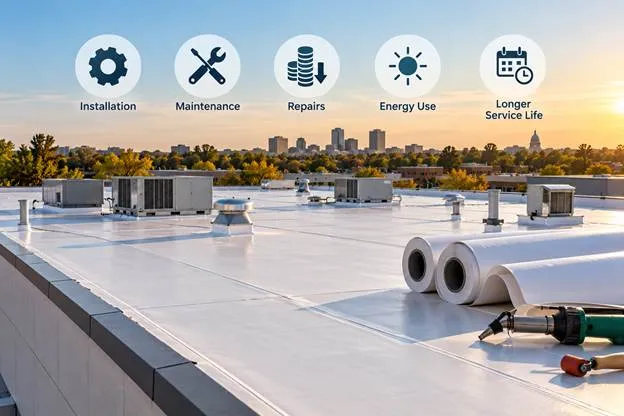
Property owners should consider the complete life-cycle cost of the roof. That includes installation, maintenance, repairs, energy use, expected service life, and eventually replacement.
TPO can be attractive because it often balances those factors well.
Its relatively lightweight design may simplify certain installation requirements compared with heavier roof assemblies. Large sheets can cover significant roof areas efficiently, which is particularly useful for commercial buildings with broad, open roof surfaces.
The welded seams are also designed to create strong connections between membrane sections. If the system is installed correctly and maintained over time, property owners may be able to reduce the likelihood of recurring problems related to weak or poorly sealed seams.
This does not mean TPO roofs are maintenance-free. No roofing system is. However, periodic inspections and timely repairs can help control costs by catching small issues before they affect larger portions of the roof.
Energy Efficiency Matters in Sacramento’s Climate
Sacramento summers regularly place significant demand on air-conditioning systems.
A roof exposed to hours of direct sunlight can absorb a substantial amount of heat. That heat can contribute to higher rooftop temperatures and, depending on the building assembly, increase the cooling load inside the structure.
A reflective TPO membrane is designed to send more solar energy away from the roof instead of absorbing as much of it.
For commercial properties with large flat roofs, the difference can be especially meaningful because the roof represents a considerable portion of the building’s sun-exposed surface.
Energy performance depends on more than the roofing membrane alone. Insulation levels, ventilation, building orientation, HVAC efficiency, air sealing, and occupancy patterns all play a role. Still, choosing a reflective roofing surface can be one piece of a broader strategy for managing cooling demands.
Property owners should think of TPO as part of the building envelope rather than simply a waterproof covering.
TPO Roofing Can Help Support Long-Term Durability
Sacramento roofs experience repeated heating and cooling cycles throughout the year.
Roofing materials expand as temperatures rise and contract as temperatures fall. Over time, this movement can place stress on seams, flashing, penetrations, and other details.
TPO membranes are designed with flexibility that allows the material to accommodate normal movement in the roofing system.
The membrane can also offer resistance to common rooftop challenges such as moisture, UV exposure, and routine weathering. However, durability still depends heavily on the quality of the entire installation.
A strong membrane will not compensate for poorly completed flashing around rooftop equipment. Likewise, a good seam weld will not solve drainage problems caused by standing water or blocked roof drains.
That is why long-term roof performance should be viewed as the result of the whole system working together.
How TPO Compares With Other Flat Roofing Systems
TPO is not the only option available for flat or low-slope roofs.
Modified bitumen, PVC, EPDM, and other systems may also be appropriate depending on the property, roof design, budget, and expected use.
Modified bitumen is known for its layered construction and durability. Certain systems can perform well in areas where puncture resistance is important, but darker surfaces may absorb more heat unless a reflective coating or cap sheet is used.
PVC roofing shares some similarities with TPO, including light-colored membranes and heat-welded seams. It may be preferred in certain commercial environments, particularly where chemical resistance is an important consideration, although material and installation costs can differ.
EPDM is another established membrane option. It is commonly black and has a long history of use, although its thermal characteristics differ from reflective white membranes.
TPO often appeals to owners looking for a combination of reflectivity, seam strength, installation efficiency, and manageable long-term costs.
The right choice depends on the building rather than on which material is most popular.
Roof Drainage Is Just as Important as the Membrane
Flat roofs are not truly flat.
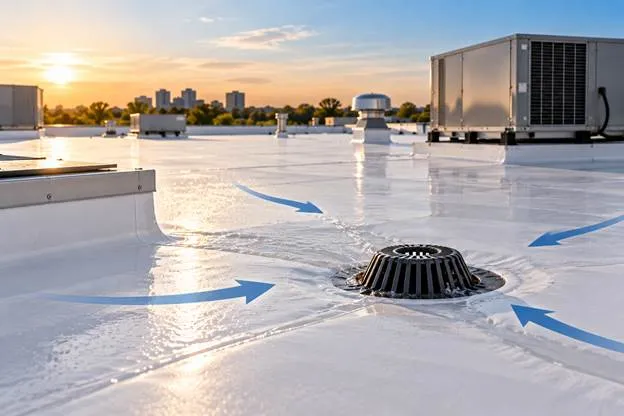
They are designed with slight slopes that direct water toward drains, scuppers, gutters, or other drainage points. If those pathways become blocked or the roof does not drain correctly, water can remain on the surface longer than intended.
Standing water adds weight and can increase stress on vulnerable areas of the roofing system.
During a TPO roofing project, contractors should evaluate drainage conditions along with the membrane itself. Roof drains, penetrations, transitions, and low areas deserve close attention.
Property owners can also help protect the roof after installation by keeping debris away from drains and scheduling inspections after major storms or whenever drainage problems become noticeable.
This type of maintenance may seem simple, but it can have a significant effect on long-term roof performance.
Why Professional TPO Installation Matters
TPO installation requires more than rolling out membrane sheets.
Seams must be welded correctly. Roof edges, penetrations, mechanical equipment, and transitions must be detailed carefully. The membrane must also be secured according to the roofing design and installation method.
A poorly welded seam may appear acceptable at first but become vulnerable over time. Improper flashing can create entry points for water, while inadequate preparation of the roof deck can affect the finished system.
Experienced contractors also evaluate what lies underneath the membrane.
Insulation, decking, existing moisture, drainage conditions, and previous roof systems may all influence how a new TPO roof should be installed.
Professional installation therefore protects more than the appearance of the finished roof. It helps ensure that the roofing system performs as intended from the membrane down.
When TPO May Be a Good Choice
TPO is commonly considered for commercial buildings, multifamily properties, offices, retail spaces, warehouses, and other structures with flat or low-slope roofs.
Certain residential properties with low-slope additions, garages, or modern roof designs may also be candidates.
Before selecting the material, property owners should evaluate the condition of the existing roof, insulation needs, drainage, rooftop equipment, access, and future maintenance expectations.
A roof that experiences frequent foot traffic may require additional protection in service areas. Buildings with numerous HVAC units may need more detailed flashing around penetrations. Older buildings may also need repairs to decking or insulation before a new membrane is installed.
These details help determine whether TPO is simply an available option or the right option for the property.
Maintenance Helps Protect the Investment
TPO roofing is relatively straightforward to maintain, but regular attention still matters.
Property owners should have the roof checked periodically for damaged membrane areas, seam concerns, punctures, blocked drainage, flashing deterioration, and debris accumulation.
Roof access should also be managed carefully. HVAC technicians, electricians, and other contractors sometimes work on rooftop equipment, and tools or sharp objects can damage membrane surfaces.
After major mechanical work, it can be helpful to inspect nearby roofing areas for accidental punctures or displaced materials.
Preventive maintenance allows property owners to address small issues while they are still manageable.
FAQs About TPO Roofing in Sacramento
How long can a TPO roof last?
The service life of a TPO roof depends on membrane quality, installation, climate exposure, drainage, maintenance, and rooftop activity. Many systems can provide years of reliable service when properly installed and maintained. Regular inspections are important because early repairs can help prevent localized damage from becoming a larger roofing problem.
Is TPO suitable for Sacramento’s hot weather?
TPO can be a strong option for hot climates because light-colored membranes are designed to reflect a portion of the sun’s energy rather than absorb as much heat as darker surfaces. This may help reduce rooftop heat buildup and support the building’s overall energy-efficiency strategy, especially on large low-slope roofs.
Does TPO roofing require much maintenance?
TPO roofs generally require routine inspections rather than intensive ongoing maintenance. Contractors typically look at seams, flashing, drainage areas, penetrations, membrane condition, and locations around rooftop equipment. Clearing debris and addressing small damage quickly can help protect the roof and reduce the likelihood of more expensive repairs.
Can TPO roofing be installed over an existing roof?
In some cases, a new membrane system may be installed over portions of an existing roofing assembly, but this depends on building codes, roof condition, moisture levels, structural considerations, and the existing materials. A professional inspection is necessary before deciding whether an overlay or complete tear-off is the better approach.
Is TPO only for commercial buildings?
No. TPO is widely associated with commercial roofing because many commercial buildings have large flat or low-slope roofs, but it can also be appropriate for certain residential applications. Homes with low-slope additions, patios, garages, or contemporary roof designs may benefit from a membrane roofing system depending on the structure.
Talk to Apollo Roofing Company About TPO Roofing in Sacramento
TPO roofing can offer Sacramento property owners a practical balance of reflectivity, durability, installation efficiency, and manageable long-term maintenance. Its value is strongest when the roof is designed around the actual building, installed carefully, and maintained after installation.
Apollo Roofing Company can evaluate your flat or low-slope roof, identify existing conditions, review drainage and insulation considerations, and explain whether TPO is suitable for your property.
If your current roof is aging, experiencing leaks, or becoming expensive to maintain, contact Apollo Roofing Company to schedule an evaluation and learn whether a TPO roofing system makes sense for your Sacramento property.
