
Trusted Roofing Contractor in California
San Francisco›Commercial Roof Replacement
Offices, retail, apartment buildings and warehouses. We replace commercial flat roofs with systems that meet California’s energy code, and we plan the work so tenants and customers can stay.
CSLB License Number: #1076767
and clear, written estimates
44 Gough St, Suite 215, San Francisco, CA 94103
Patching a tired flat roof buys time, but each repair costs more than the last. When leaks reach tenants, inventory or equipment, replacement is usually the better business decision.
Most commercial roofs in San Francisco are flat or low-slope, often surrounded by parapets and crowded with HVAC units, vents and ductwork. Drains clog, seams open around equipment and the membrane wears out under years of sun. We look at the whole roof, including insulation and drainage, before recommending a replacement.
Want a ballpark first? Read our guide to commercial roof replacement cost.
As a GAF GoldElite commercial contractor and Polyglass Registered Contractor, we install proven low-slope systems backed by manufacturer warranties on qualifying projects.
A bright white, heat-welded membrane that helps meet cool roof rules. Read what to know before choosing TPO in San Francisco.
Tough multi-layer systems that handle foot traffic well. Compare them in TPO vs. modified bitumen.
New tapered insulation, drains and scuppers to move water off the roof.
A written plan before work starts, and a building that stays weather-tight every night.
We inspect the membrane, insulation, drains and rooftop equipment.
A written plan covering system, warranty, permit, phasing and safety.
We pull the DBI permit and confirm Title 24 cool roof requirements.
We work section by section so the building stays weather-tight and in use.
| System | Good fit for |
|---|---|
| TPO | Large flat roofs where reflectivity and energy savings matter. White TPO is a common way to meet cool roof rules. |
| Modified bitumen | Roofs with regular foot traffic, roof decks or many penetrations. |
| Torch down | Smaller flat roofs on mixed-use and apartment buildings. |
| Roof coating | Roofs that are still sound and dry. A coating can delay a full replacement. |
| Every building is different. We recommend a system after inspecting your roof, not before. | |
Commercial reroofs in San Francisco must meet state energy rules and city permit requirements. We handle both.
Under California’s Title 24 energy code, when more than half of a nonresidential low-slope roof, or more than 2,000 square feet (whichever is less), is replaced, recovered or recoated, the new surface generally must be a rated cool roof: aged solar reflectance of at least 0.63 and thermal emittance of at least 0.75, or an SRI of at least 75. There are insulation-based alternatives, and we confirm the right path for your building.
DBI requires a permit before roofing material is installed or removed. For commercial buildings replacing more than half the roof area or 2,000 square feet, the city also asks for cool roof information. Read more about roofing permits in San Francisco.
The California Building Code does not allow a recover over two or more existing roof layers, or over a wet or deteriorated roof. A tear-off to the deck lets us replace wet insulation and damaged decking.
We schedule noisy work around your hours where possible, keep exits and entrances clear, and close up each section at the end of the day.
Sources: California Energy Commission, 2025 Nonresidential Cool Roofs; San Francisco DBI reroofing permit page; 2025 California Building Code §1512.
Commercial roofs our crews have replaced and restored in San Francisco.
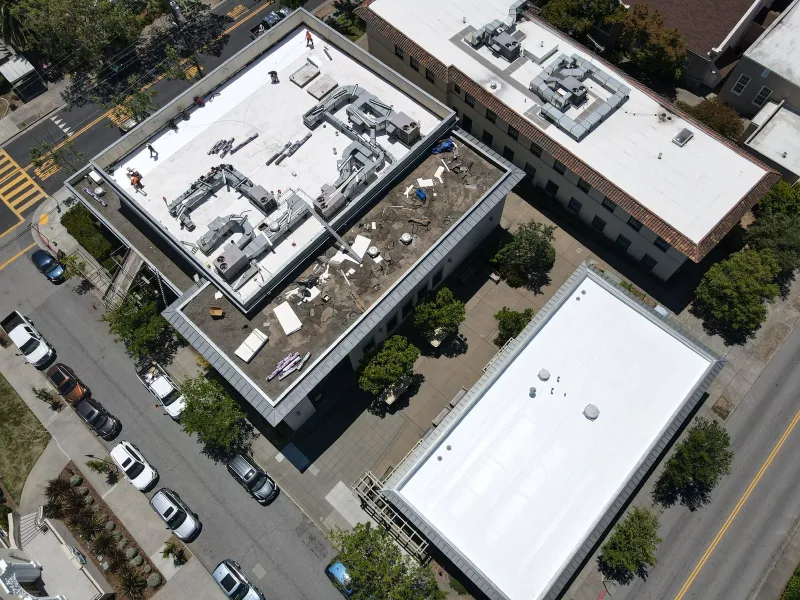
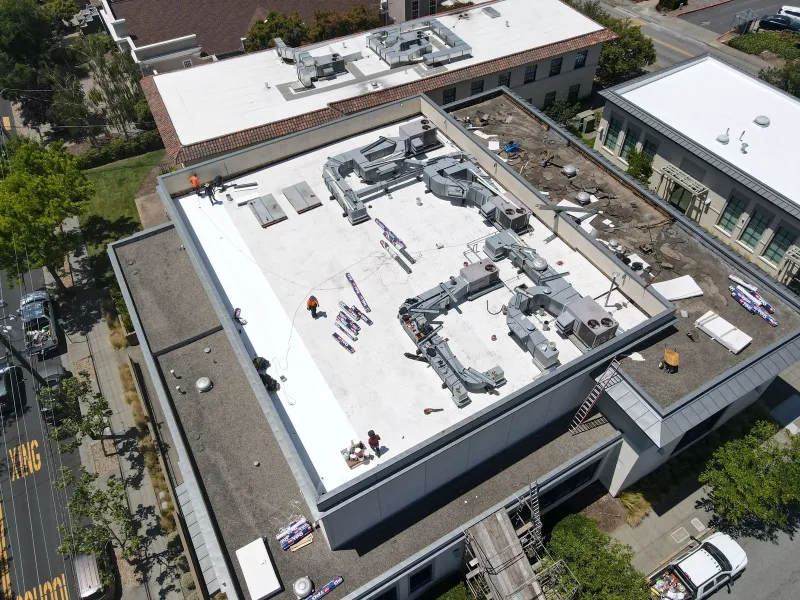
On this large commercial building, we replaced the flat roof with a bright white TPO membrane. The crew worked around the rooftop HVAC units and ductwork while the building stayed in use.
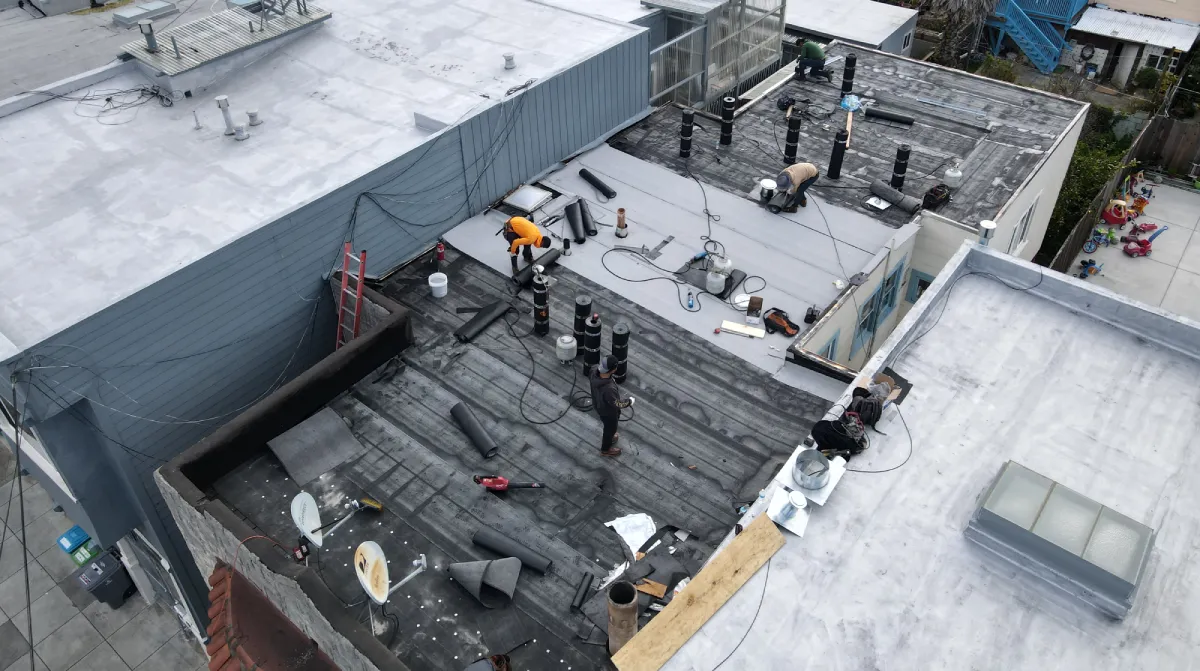
A low-slope roof brought back to a clean, sealed surface, with new flashing around the skylight and roof vents.
Usually, if it is low-slope and you are replacing more than 50% of it or more than 2,000 square feet, whichever is less. California’s Title 24 energy code applies this to nonresidential low-slope reroofs in every climate zone, including San Francisco. Insulation trade-offs exist, and we confirm what applies.
In most cases, yes. We phase the work section by section and keep the building weather-tight each night.
Both are proven. TPO is very reflective and suits large open roofs. Modified bitumen handles foot traffic and lots of penetrations well. See our TPO vs. modified bitumen comparison.
Yes. We apply for the San Francisco DBI permit, provide the cool roof information the city asks for, and schedule inspections.
As a GAF GoldElite commercial contractor and Polyglass Registered Contractor, we can offer manufacturer warranties on qualifying systems, plus our own workmanship warranty. Terms depend on the system you choose.
Every job starts with a free inspection and a written estimate that spells out materials, labor, warranty, permit requirements and timeline. We show you what we found, explain your options in plain words, and keep your property clean while we work.
Apollo Roofing Company is licensed under CSLB License #1076767 and certified by leading manufacturers. See our certifications or read why property owners choose us.
44 Gough St, Suite 215
San Francisco, CA 94103
Services and guides for San Francisco property owners and managers.
We use cookies to improve your experience and to record and monitor communications on our site. By using our site, you consent to our use of cookies and agree to our Privacy Policy and Terms of Use.
Manage your cookie preferences below:
Essential cookies enable basic functions and are necessary for the proper function of the website.
These cookies are needed for adding comments on this website.
Google Tag Manager simplifies the management of marketing tags on your website without code changes.
Statistics cookies collect information anonymously. This information helps us understand how visitors use our website.
Service URL: www.apolloroofingcompany.com (opens in a new window)
Google Analytics is a powerful tool that tracks and analyzes website traffic for informed marketing decisions.
Service URL: policies.google.com (opens in a new window)
Marketing cookies are used to follow visitors to websites. The intention is to show ads that are relevant and engaging to the individual user.
Facebook Pixel is a web analytics service that tracks and reports website traffic.
Service URL: www.facebook.com (opens in a new window)
You can find more information in our Privacy Policy and Terms of Service.