

Commercial property owners rarely start thinking about a new roof because they want another capital expense. Usually, an aging membrane, recurring leaks, planned renovations, or concerns about long-term building performance bring roofing costs into focus.
TPO has become a common choice for flat and low-slope commercial roofs because it combines a reflective surface with heat-welded seams and a relatively straightforward single-ply design. For Los Angeles building owners, however, the final price can vary considerably from one property to another.
Understanding TPO roofing cost Los Angeles estimates starts with recognizing that contractors are pricing an entire roofing system, not simply a roll of membrane. Roof size matters, but insulation, existing conditions, access, penetrations, attachment methods, and the amount of preparation required can have just as much influence on the final proposal.
What Does TPO Roofing Cost Per Square Foot Include?
The TPO roofing cost per square foot is commonly used as a planning tool because commercial roofs can cover thousands or even tens of thousands of square feet. Current 2026 industry guides generally place installed TPO within a broad range, with many estimates falling between roughly $5.50 and $12 per square foot nationally. Los Angeles-specific estimates may reach approximately $8 to $12.50 per square foot for many commercial projects.
These figures should not be treated as a quote for a particular building. A relatively open warehouse roof with straightforward access may require far less detailed work than a roof crowded with HVAC units, drains, pipes, curbs, parapets, and other penetrations.
Installed pricing can account for membrane, labor, flashing, fastening or adhesive materials, and other components. Insulation, tear-off, deck repairs, permits, engineering, disposal, and specialty details may increase the total depending on the project.
Why Roof Size Does Not Tell the Whole Cost Story
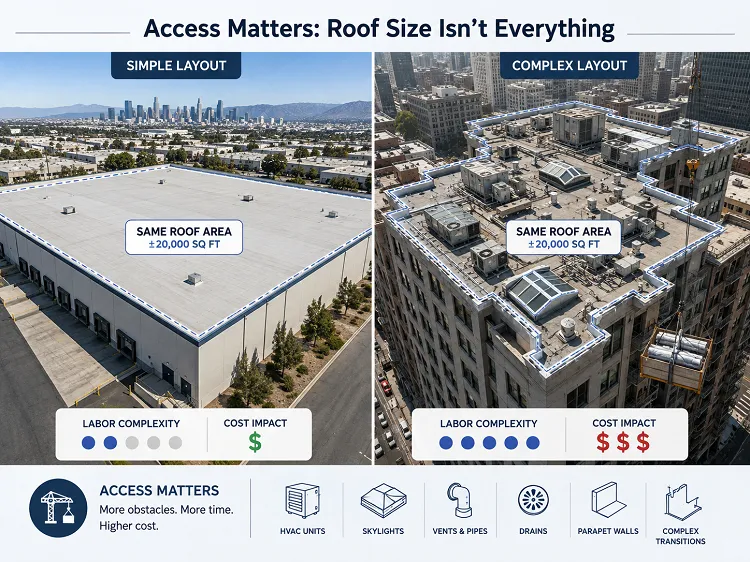
Square footage provides a useful starting point, but two buildings with identical roof areas can produce very different estimates.
A large warehouse with wide, uninterrupted roof sections may allow installers to work efficiently. A smaller commercial property could require considerably more labor per square foot if crews must navigate numerous mechanical systems, skylights, walls, drains, and complicated transitions.
Roof access can also matter. Moving materials onto a low, easily accessible building is different from coordinating equipment and crews on a taller property in a dense Los Angeles neighborhood.
This is why multiplying roof area by an online average rarely produces an accurate budget. The roof needs to be evaluated as a physical working environment.
Existing Roof Conditions Can Change the Price
What sits beneath the existing surface can be one of the biggest variables in a commercial roofing project.
If the current system is eligible for a recover installation and the underlying assembly remains suitable, the scope may differ substantially from a project requiring complete removal. When tear-off is necessary, crews must remove and dispose of old roofing before evaluating the deck and preparing it for the replacement system.
Once the existing material comes off, previously hidden deterioration may become visible. Wet insulation, damaged decking, corrosion, or other substrate problems can require additional work.
A thorough inspection before estimating commercial TPO roofing Los Angeles projects helps reduce surprises by giving the contractor a better understanding of the existing assembly and areas that may require special attention.
Membrane Thickness Can Affect the Investment
TPO membranes are available in different thicknesses, commonly expressed in mils. A thicker membrane generally costs more, but membrane selection should not be based on price alone.
The appropriate choice depends on building use, expected rooftop traffic, desired warranty, system design, and long-term ownership plans. Current commercial pricing guides show that 60-mil and 80-mil systems often cost more than thinner options, particularly once insulation and installation requirements are included.
For an owner planning to keep a building for many years, comparing the complete roofing assembly can be more useful than focusing exclusively on the lowest initial price.
Insulation Is an Important Part of the Roofing System
The visible white membrane is only one component of a TPO roof.
Commercial roofing assemblies may incorporate insulation beneath the membrane to support thermal performance and satisfy project or code requirements. The type, thickness, and number of insulation layers can meaningfully affect project cost.
Some roofs may also need tapered insulation to improve drainage by directing water toward drains or scuppers. This can increase material and installation requirements, but addressing drainage is important because persistent ponding and poor water movement can create additional stress on a roofing system.
When reviewing a proposal, property owners should understand what insulation is included instead of comparing membrane prices alone.
Roof Penetrations and Perimeter Details Require More Labor
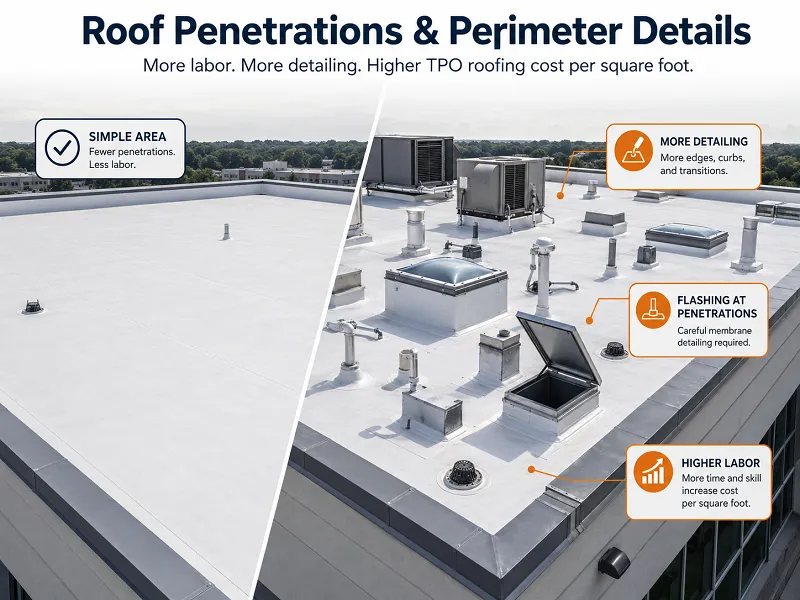
Commercial roofs are rarely empty surfaces. HVAC equipment, vents, exhaust fans, pipes, skylights, access hatches, drains, and other features create areas where the membrane must be carefully detailed.
These sections require more hands-on labor than open roof areas. Flashing must transition correctly around curbs and penetrations, while perimeter areas need proper termination and attachment.
A building with dozens of rooftop units may therefore have a higher TPO roofing cost per square foot than a similarly sized building with relatively few obstacles.
These details are also critical to performance. Saving money by rushing flashing work can undermine the value of the entire roof installation.
Attachment Method Can Influence Pricing
TPO systems may be mechanically attached or fully adhered, depending on the roof design and project requirements.
Mechanically attached systems use fasteners and plates to secure components to the underlying structure. Fully adhered systems bond the membrane across a greater portion of the roof surface using compatible adhesives.
Each approach has different labor, material, deck, and design considerations. Current estimating benchmarks show fully adhered assemblies can carry higher installed costs than comparable mechanically attached systems.
The appropriate system should be selected according to the building, wind requirements, existing roof conditions, manufacturer specifications, and project goals rather than cost alone.
Why a Commercial Roof Inspection Matters Before Budgeting
Online ranges are useful for early planning, but a roof inspection turns a broad estimate into information that is specific to the building.
A roofer can assess membrane condition, drainage, flashing, penetrations, rooftop equipment, existing insulation concerns, deck conditions that can be observed, access, and other factors that influence the scope.
For owners researching TPO roofing cost Los Angeles, this evaluation can also help determine whether complete replacement is currently necessary. Depending on the condition of the roof, repairs, maintenance, or another roofing strategy may deserve consideration before committing to a full replacement.
FAQs About TPO Roofing Cost in Los Angeles
How much should I budget for a commercial TPO roof in Los Angeles?
There is no universal price that applies to every property. Current 2026 market guides show broad installed ranges, while Los Angeles estimates can trend higher due to labor, access, insulation, project complexity, and local requirements. A roof-specific inspection is the best way to establish a realistic budget.
Why can two TPO roofing estimates be very different?
Two proposals may include different membrane thicknesses, insulation levels, tear-off requirements, attachment methods, warranties, flashing details, deck repairs, or disposal costs. Property owners should compare the complete scope of work instead of assuming the lowest total represents the same roofing system.
Does replacing a larger commercial roof always cost more per square foot?
A larger roof usually increases the total project investment, but it does not automatically mean the highest unit price. Large, open roof areas can sometimes be more efficient to install than smaller roofs filled with penetrations and complicated details. Access, preparation, insulation, and existing conditions still influence pricing.
Is TPO a good option for commercial buildings in Los Angeles?
TPO can be suitable for many flat and low-slope commercial properties because it offers a reflective surface, welded seams, and multiple system configurations. Whether it is appropriate for a specific building depends on roof design, drainage, deck condition, rooftop activity, budget, and long-term ownership goals.
Know What to Expect for TPO Roofing Cost in Los Angeles with Apollo Roofing Company – Call Us!
A commercial roof is too important to budget using square footage alone. Membrane thickness, insulation, drainage, penetrations, tear-off requirements, access, attachment methods, and existing roof conditions all contribute to what a property owner ultimately pays.
Apollo Roofing Company can evaluate your building and explain which factors are shaping the cost of commercial TPO roofing Los Angeles properties require. Instead of relying on a generic online estimate, you can make decisions based on your actual roof, building needs, and long-term priorities.
Call Apollo Roofing Company to schedule a commercial roofing assessment and get a clearer understanding of the TPO system, scope, and investment appropriate for your Los Angeles property.
