

Commercial roofs in Los Angeles deal with conditions that can quietly wear them down long before a leak becomes obvious. Strong sunlight, prolonged heat, rooftop equipment, foot traffic, windblown debris, drainage problems, and normal material aging can all affect performance over time.
For building owners and facility managers, commercial roof maintenance Los Angeles services provide a way to catch those changes before they develop into larger problems. Instead of waiting for ceiling stains or water intrusion to signal trouble, a maintenance plan creates regular opportunities to evaluate the roof, document its condition, and address manageable issues earlier.
The value is not simply having someone look at the roof. A useful maintenance program creates a clearer picture of how the roofing system is aging and what may require attention next.
Why Commercial Roof Maintenance Matters in Los Angeles
Los Angeles may not experience the same freeze-thaw cycles common in colder climates, but commercial roofs here face their own demanding conditions.
UV exposure can gradually affect membranes, coatings, sealants, and flashing materials. Hot daytime temperatures followed by cooler evenings cause roofing components to expand and contract. Over thousands of cycles, that movement can place stress on seams, penetrations, edges, and other vulnerable areas.
Commercial properties also tend to have more rooftop activity than residential buildings. HVAC technicians, electricians, solar contractors, and other service professionals may regularly access the roof. Even when everyone works carefully, repeated traffic can contribute to punctures, scuffs, displaced materials, or localized wear.
Regular maintenance helps identify these changes before they become harder to manage.
What Commercial Roof Maintenance Plans Include
The exact scope varies by contractor and building, but commercial roof maintenance plans Los Angeles property owners consider often center on scheduled inspections, drainage checks, debris removal, documentation, and identification of developing problems.
During a maintenance visit, a roofing professional may examine membrane surfaces, seams, flashings, penetrations, roof edges, drains, gutters, scuppers, and areas around mechanical equipment.
Minor maintenance may also be included depending on the agreement. That could involve limited sealant touch-ups, clearing debris from drainage areas, or addressing small conditions that can reasonably be corrected during the visit.
The important distinction is between maintenance and larger repair work. A plan should clearly explain which services are included and which conditions would require a separate repair proposal.
What Does Commercial Roof Maintenance Cost?
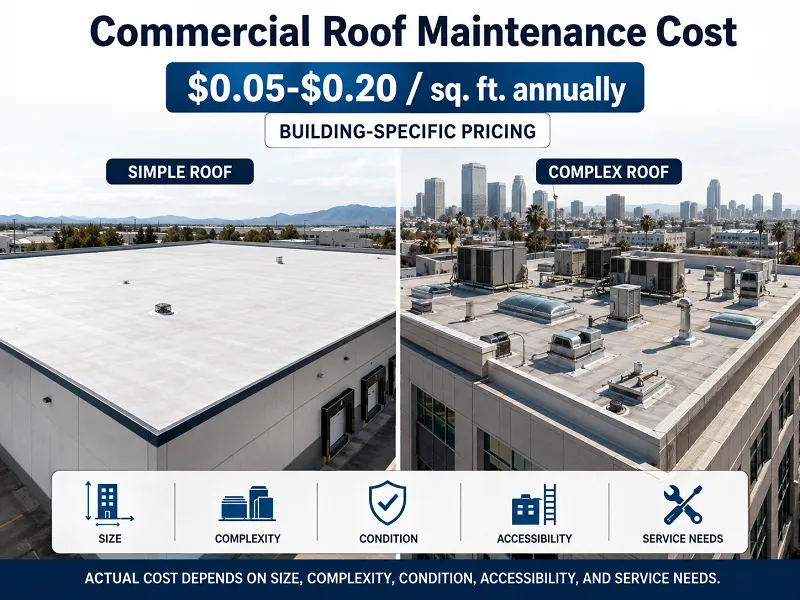
There is no universal annual rate because commercial roofs differ considerably in size, complexity, condition, accessibility, and service needs.
Recent industry pricing guides commonly place structured commercial roof maintenance programs within a broad range of roughly $0.05 to $0.20 per square foot annually. Some basic inspection-focused programs may fall below that range, while larger, older, or more complicated roofs can cost more.
The commercial roofing maintenance cost Los Angeles property owners receive should therefore be treated as building-specific rather than based on a single online average.
A relatively new, open warehouse roof may be straightforward to inspect. A multilevel building with numerous HVAC units, skylights, parapets, drains, and difficult access can require significantly more time and attention.
What matters most is understanding what the quoted price actually covers.
What Determines the Price of a Maintenance Plan?
Roof size naturally affects pricing because larger areas take longer to inspect and maintain. Size, however, is only one part of the equation.
Existing roof condition can make a substantial difference. A well-maintained system with clear drains and limited wear may require less immediate attention than a roof that has gone years without professional inspection.
Access also matters. Some roofs can be reached easily through an interior hatch or exterior ladder. Others may require additional safety equipment or more complicated coordination.
Rooftop equipment adds another consideration. Each HVAC curb, pipe, vent, skylight, drain, wall transition, or penetration creates an area that needs careful inspection.
Service frequency can influence pricing as well. An annual inspection program will have a different scope from a plan that includes two scheduled visits, additional storm evaluations, minor repairs, or priority service.
Preventive Maintenance Can Reduce Roofing Surprises
One of the biggest benefits of a maintenance plan is visibility.
Roof deterioration frequently develops slowly. A small opening at a flashing detail or weakened section of sealant may not immediately cause water to appear inside the building. Moisture can travel through portions of the roof assembly before becoming noticeable indoors.
By the time a leak reaches ceiling tiles, insulation or other materials may already have been exposed.
Scheduled maintenance gives roofing professionals opportunities to spot visible warning signs sooner. Open seams, punctures, deteriorated sealants, damaged flashing, clogged drains, loose materials, and unusual surface conditions can be documented before they become emergency calls.
Preventive care cannot eliminate every roofing problem, but it can make roof management considerably more predictable.
Maintenance Can Support Longer-Term Roof Planning
Commercial property owners often have to balance maintenance budgets with larger capital improvements. A roof maintenance history can help make those decisions more informed.
Instead of discovering unexpectedly that a roof requires major work, building owners can follow changes in its condition over several inspections. If certain areas begin deteriorating faster, those conditions can be monitored and addressed accordingly.
This makes it easier to distinguish between a roof that needs routine attention and one that may be approaching the point where restoration or replacement should enter the budget.
Well-documented maintenance can therefore become part of broader asset planning rather than simply another operating expense.
Why Roof Documentation Is Valuable
A professional maintenance visit should leave the property owner with more than a verbal statement that everything looks fine.
Photos, inspection notes, repair recommendations, and condition reports establish a record of what was observed at a particular point in time. Future inspections can then be compared with previous findings.
Documentation is especially useful for buildings managed by multiple people. Property managers, facility directors, ownership groups, and future staff members may all need access to the roof’s maintenance history.
Certain roofing warranties may also include maintenance or inspection requirements. Building owners should review the specific terms of their warranty and maintain records accordingly rather than assuming every program satisfies every manufacturer’s requirements.
When Should Commercial Roof Maintenance Be Scheduled?
Maintenance frequency should reflect the roofing system, roof age, warranty terms, building activity, and existing condition.
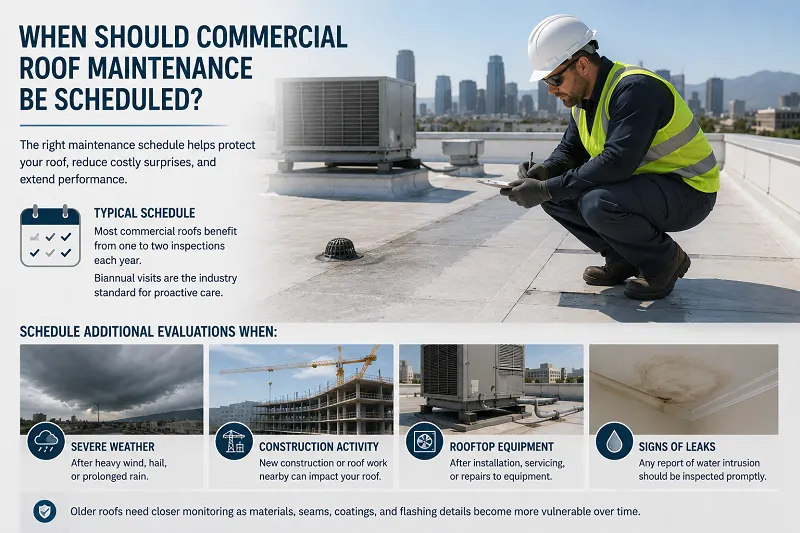
Many commercial roofing programs are built around one or two scheduled inspections each year. Industry sources commonly describe biannual visits as a typical approach for structured maintenance programs.
Additional evaluations may make sense after unusually severe weather, construction activity, installation or servicing of rooftop equipment, or reports of water intrusion.
Older roofs may also deserve closer monitoring because materials, seams, coatings, and flashing details can become more vulnerable as they age.
What Should Property Owners Expect After a Maintenance Visit?
A useful maintenance program should provide clear information about what was inspected, what was found, and what should happen next.
Some roofs may need little beyond routine cleaning and continued observation. Others may have minor issues worth addressing before the next scheduled visit. More significant concerns should be explained separately so property owners can understand their urgency and potential consequences.
Comparing commercial roof maintenance plans Los Angeles businesses are considering should involve more than comparing annual fees. Owners should look at inspection frequency, documentation, included maintenance, communication, repair procedures, and how recommendations are prioritized.
The lowest-priced agreement may not provide the most useful level of roof management.
FAQs About Commercial Roof Maintenance
How often should a commercial roof in Los Angeles receive professional maintenance?
The appropriate schedule depends on the roof’s age, material, condition, warranty requirements, and the amount of rooftop activity. Many commercial properties benefit from one or two scheduled inspections annually, along with additional evaluations after major weather events, construction work, equipment servicing, or signs of leakage.
How can regular maintenance help a commercial roof?
Maintenance gives roofing professionals opportunities to identify visible deterioration before it develops further. Problems such as open seams, deteriorated sealants, clogged drains, damaged flashing, punctures, or surface wear can be documented and addressed based on their severity, helping owners manage the roof more proactively.
Is a maintenance plan still worthwhile if the roof is not leaking?
Yes. Waiting for a leak means relying on interior water intrusion as the first warning sign of a roofing problem. Regular commercial roof maintenance Los Angeles property owners schedule can help identify changes while they are still confined to the roof, giving building managers more time to evaluate appropriate repairs and budget for future needs.
Are repairs included in commercial roof maintenance programs?
It depends on the agreement. Some plans include limited preventative work or small sealant repairs, while larger repairs are priced separately. Property owners should ask exactly what is covered before signing a maintenance agreement so there is a clear distinction between routine service and billable repair work.
How should I compare maintenance plan pricing?
Rather than comparing the annual price alone, review inspection frequency, reporting, drainage maintenance, minor repair allowances, emergency response terms, and exclusions. The commercial roofing maintenance cost Los Angeles building owners pay is most meaningful when evaluated alongside the actual scope and condition of the roof.
Protect Your Property with Commercial Roof Maintenance in Los Angeles from Apollo Roofing Company
A commercial roof represents a significant investment, and managing it proactively can provide greater visibility into its condition, repair needs, and long-term outlook.
Apollo Roofing Company can evaluate your Los Angeles commercial roof and help identify maintenance priorities based on the roofing system, building configuration, existing condition, and areas most vulnerable to wear.
Whether you manage an office building, retail property, warehouse, or another commercial facility, having a consistent roofing strategy can help reduce unexpected problems and support better budgeting. Contact Apollo Roofing Company to schedule a commercial roof evaluation and discuss a maintenance approach built around your property.
