

A warehouse roof has a demanding job. It may cover thousands of square feet, surround vents and mechanical equipment, handle drainage across long roof runs, and protect inventory, machinery, employees, and day-to-day operations below.
That is why choosing a commercial roofing system should involve more than comparing material names or selecting the lowest proposal. The right roof needs to match the building itself, including its slope, drainage design, structural conditions, rooftop equipment, interior use, and long-term maintenance needs.
For property owners researching the best commercial roofing systems for warehouses in Novato, there is no single material that automatically works for every facility. Several proven systems are available, and understanding how they perform can make conversations with a roofing contractor far more productive.
What Makes Warehouse Roofing Different?
Warehouses and industrial buildings often have large, low-slope roof areas. That creates different challenges than those found on a typical steep-slope residential roof.
Water has to travel efficiently toward drains, gutters, or scuppers. Seams, penetrations, flashing, roof edges, and transitions require careful detailing. HVAC units, exhaust vents, skylights, pipes, and other equipment can also create additional areas that need to be incorporated into the roofing assembly correctly.
Industrial operations can add another layer of complexity. Heat, moisture, rooftop traffic, exhaust, and the activities taking place inside the facility may influence what the roof needs to handle.
This is why experienced warehouse roofing contractors in Novato should evaluate the entire building rather than recommend a material based solely on roof size.
TPO Roofing for Large Low-Slope Buildings
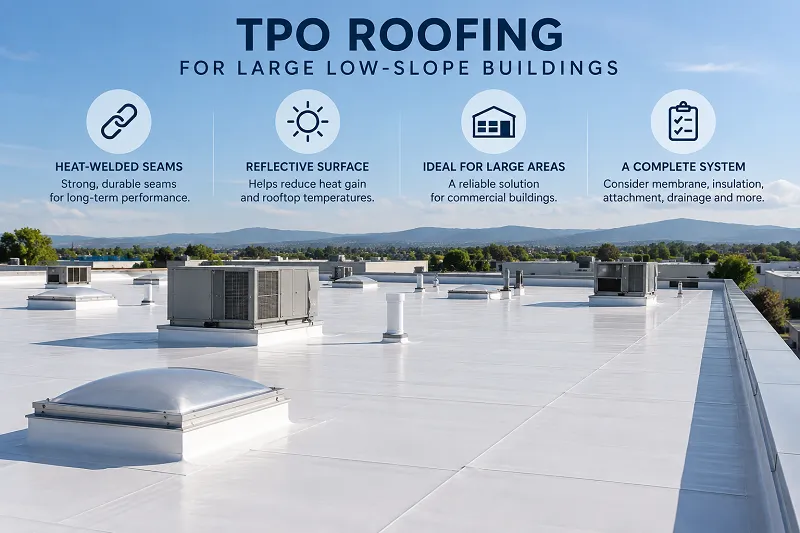
Thermoplastic polyolefin, commonly called TPO, is a single-ply roofing membrane frequently used on commercial buildings.
One reason TPO is well suited to large roof areas is its heat-welded seam construction. Rather than relying solely on adhesives at membrane seams, properly installed TPO systems use hot-air welding to join membrane sections.
TPO is also commonly available in light-colored, reflective surfaces. That can make it worth considering for facilities where solar heat gain and rooftop temperatures are important concerns.
However, selecting TPO is only part of the decision. Membrane thickness, attachment method, insulation, cover boards, flashing details, drainage, penetrations, and manufacturer specifications can all affect the completed assembly.
A good TPO proposal should therefore describe more than the membrane itself.
Modified Bitumen Roofing for Multi-Layer Protection
Modified bitumen combines asphalt-based roofing technology with polymer modification. Depending on the system, installation methods can include self-adhered, cold-applied, hot-asphalt, or torch-applied components.
Its layered construction can make modified bitumen attractive for commercial roofs where durability and resistance to rooftop activity are priorities.
Still, the installation method matters. Building use, fire-safety considerations, existing materials, local requirements, and manufacturer specifications should all be considered when determining whether a particular modified bitumen assembly makes sense.
For warehouses where employees or service technicians regularly access rooftop equipment, contractors may also recommend designated walk pads or other measures to reduce unnecessary wear.
Built-Up Roofing Remains Relevant for Some Facilities
Built-up roofing, often shortened to BUR, has been used on low-slope commercial buildings for generations. These systems generally consist of multiple layers of reinforcing material and bitumen, creating a substantial roofing assembly.
That redundancy can be valuable, particularly on buildings where durability is a major priority. At the same time, built-up roofing can be heavier and more labor-intensive than some single-ply alternatives.
Existing structural conditions and roof configuration therefore deserve consideration before a system is specified.
For an older Novato warehouse, the evaluation may also reveal that previous roofing work has left multiple layers in place. Understanding what is already on the deck can influence both removal requirements and the options available for the next roof.
Metal Roofing for Appropriate Warehouse Designs
Metal roofing can provide an effective solution for warehouses and industrial facilities with suitable roof slopes and structural designs.
Standing seam metal systems use raised seams and typically conceal fasteners from direct weather exposure. Properly designed metal roofs can provide long service life, effective water shedding, and a clean appearance.
Metal is not automatically the right choice for every industrial property, however. Roof geometry, slope, penetrations, expansion and contraction, flashing details, drainage, and structural requirements all need consideration.
For some facilities, metal may be an excellent long-term solution. For others, a low-slope membrane system may better match the existing building.
Insulation and Drainage Matter as Much as the Surface
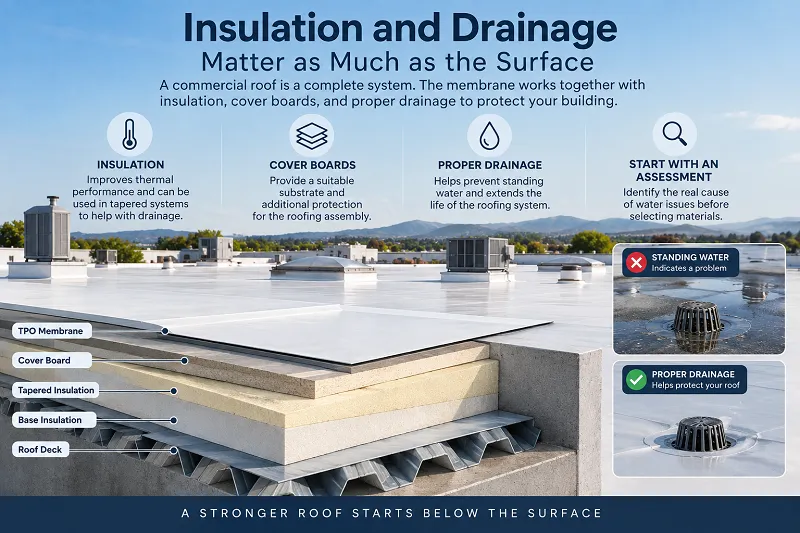
A roofing membrane is the most visible part of many commercial roof systems, but it does not work alone.
Insulation can affect thermal performance and may also be incorporated into tapered systems designed to improve drainage. Cover boards can provide a suitable substrate and additional protection depending on the assembly.
Drainage deserves particular attention on expansive warehouse roofs. Standing water may indicate clogged drains, inadequate slope, settlement, or another underlying issue. Simply installing a new membrane without addressing the cause can carry an old problem into a new roofing system.
This is one reason commercial roof planning should begin with a thorough assessment rather than a material selection.
Compare Complete Roofing Systems, Not Just Materials
Two contractors can both propose TPO and still be proposing substantially different roofs.
Membrane thickness, insulation, cover board, attachment method, flashing, edge details, drainage improvements, penetrations, tear-off scope, warranties, and preparation can differ from one estimate to another.
Property owners should ask what is included, what is excluded, and how unexpected deterioration will be handled if it becomes visible during removal.
Experienced warehouse roofing contractors in Novato should also be able to explain why a proposed assembly fits the facility rather than simply identifying the product they intend to install.
That conversation can reveal far more than the total at the bottom of an estimate.
Think Beyond Installation Day
A commercial roof should be evaluated with years of ownership in mind.
Consider how frequently rooftop equipment requires servicing. Think about who will access the roof, where they will walk, how drainage components will be maintained, and how easily future repairs can be completed.
Routine inspections can help identify damaged flashing, open seams, punctures, clogged drainage components, deteriorated sealants, and other developing problems before they become larger issues.
The most appropriate industrial roofing systems in Novato are therefore not necessarily the ones with the most impressive specifications on paper. They are systems that make sense for the building, are properly installed, and can be realistically maintained throughout their service lives.
Frequently Asked Questions
What are the best commercial roofing systems for warehouses in Novato?
The best commercial roofing systems for warehouses in Novato depend on roof slope, drainage, building use, existing roof conditions, insulation requirements, rooftop equipment, and long-term maintenance priorities. TPO, PVC, EPDM, modified bitumen, built-up roofing, and metal can each be appropriate under different circumstances. A commercial roof assessment can help determine which assembly best matches a specific facility.
How do I choose between TPO, PVC, and EPDM for a warehouse?
Start with the conditions the roof actually needs to handle. Consider reflectivity, rooftop traffic, exposure associated with facility operations, drainage, penetrations, insulation, installation method, and maintenance expectations. The membrane should be evaluated as part of a complete roofing assembly rather than chosen from one characteristic alone.
Should an existing warehouse roof always be completely removed?
Not necessarily. The appropriate approach depends on existing roof assemblies, moisture conditions, deck condition, applicable codes, manufacturer requirements, and the proposed replacement system. A contractor should investigate the existing roof before determining whether removal, partial replacement, or another approach is appropriate.
How often should a commercial warehouse roof be inspected?
Inspection frequency depends on the roof system, building conditions, manufacturer recommendations, weather events, and facility operations. Many property owners schedule routine professional inspections and additional evaluations after significant weather or rooftop work. Regular checks can help uncover drainage problems, membrane damage, flashing deterioration, and issues around penetrations.
Protect Your Facility With the Best Commercial Roofing Systems for Warehouses in Novato By Apollo Roofing Company
Your warehouse roof protects much more than the building itself. It helps safeguard equipment, inventory, employees, and the operations that keep your business moving.
Apollo Roofing Company can evaluate your commercial roof, discuss the advantages and limitations of appropriate systems, and help you understand what your facility actually requires. If you are planning a warehouse roof replacement or investigating problems with an existing roof, contact Apollo Roofing Company to schedule an assessment and start with a solution built around your property.
