

Replacing a flat roof is a major investment, especially in San Francisco, where roofing costs are shaped by local labor rates, building access, permitting, energy code requirements, coastal moisture, fog, wind, and the condition of the existing roof.
If you are comparing a flat roof repair company in San Francisco or researching reliable flat roof repair companies in San Francisco, understanding the true 2026 cost factors can help you budget more accurately and make a smarter decision for your property.
Flat roofs are common across California homes, apartment buildings, commercial properties, and mixed-use buildings. They offer a clean architectural look and can be practical for dense urban areas, but they also require the right materials, proper drainage, and expert installation.
Unlike steep-slope roofs, flat roofs do not shed water as quickly. That means poor slope, weak seams, clogged drains, or aging membranes can quickly lead to leaks, ponding water, insulation damage, and interior water intrusion.
For San Francisco property owners, a flat roof replacement should not be viewed as a simple surface upgrade. It is an opportunity to improve waterproofing, energy efficiency, drainage performance, and long-term protection in a climate where fog, salt air, and moisture exposure can wear down roofing systems over time.
Understanding Flat Roof Replacement Costs in San Francisco
The cost of replacing a flat roof in San Francisco can vary widely because every roof has different conditions. In 2026, many flat roof replacement projects in San Francisco may fall between $8,000 and $30,000 or more, depending on the roof size, material, access, tear-off needs, insulation, drainage upgrades, and hidden damage.
Flat roof pricing is often calculated by square footage, but the final estimate depends on far more than size alone. A smaller roof with difficult access, multiple existing roof layers, or moisture-damaged decking may cost more than a larger roof with easy access and minimal repairs. In San Francisco, access can be a major factor because many buildings are close together, have limited staging space, or require extra care around neighboring properties.
Material selection also affects pricing. Some flat roof systems are more affordable upfront, while others cost more but provide better durability, energy performance, or resistance to punctures, UV exposure, chemicals, and fire. The best material depends on the property type, budget, local exposure, and long-term goals.
The condition of the existing roof is another major cost driver. If the old roof has trapped moisture, damaged insulation, rotted decking, ponding water, or deteriorated flashing, those issues should be corrected before the new roof is installed. Covering up hidden damage can shorten the life of the new roof and lead to more expensive repairs later.
Average Flat Roof Replacement Cost in 2026
For California flat roofs in 2026, installed pricing often falls in the range of about $4 to $15 per square foot for many common systems, though complex projects can cost more. In higher-cost markets like San Francisco, property owners should be prepared for pricing to land toward the higher end when the project involves difficult access, added insulation, tear-off, drainage corrections, or code-related upgrades.
For an average flat roof of approximately 1,500 square feet, a straightforward project may fall near the lower or middle range, while a more complex replacement can reach $20,000, $30,000, or higher. Commercial buildings, multi-family properties, and roofs with rooftop equipment often cost more because they may require additional detailing around vents, HVAC units, drains, curbs, parapet walls, and penetrations.
Because flat roof replacement costs can vary so much, an on-site inspection is the best way to get an accurate estimate. A professional roofer can evaluate the existing roof system, check for drainage issues, inspect flashing and roof edges, and determine whether the roof needs repairs beneath the membrane.
San Francisco Reroofing Permit Costs in 2026
San Francisco property owners should include permitting in their flat roof replacement budget. As of 2026, the City of San Francisco lists reroofing permit fees at $256.62 for single-family homes and duplexes and $386.22 for all other building types, though additional fees may apply depending on the project scope. The City also states that online reroofing permit applications must be submitted by a licensed C-39 roofing contractor registered with the City of San Francisco.
This matters because permits are not just paperwork. They help confirm that the project is being completed according to local requirements. For property owners, working with an experienced local contractor can make the process smoother because the roofer should understand what documentation is needed, when permits apply, and how to avoid delays.
Permitting is also one reason it is important not to choose a contractor based on price alone. If a roofing company is vague about permits or suggests skipping required steps, that can create risk for the property owner. A reputable flat roof repair company in San Francisco should be able to explain the permit process clearly before work begins.
California Title 24 and Cool Roof Requirements
Flat roof replacement in California is also influenced by state energy requirements. Under California’s building energy efficiency standards, new or replacement low-slope roofs are generally required to meet cool roof requirements. California’s Cool California resource states that all new or replacement low-slope roofs are required by Title 24 to be cool roofs.
The Cool Roof Rating Council also notes that Title 24 requirements can vary based on climate zone, building type, roof square footage, and roof slope, and that roofing products used for compliance must be rated by the CRRC.
For San Francisco property owners, this makes material selection especially important. The roof should not only stop leaks. It should also support energy performance, meet applicable code requirements, and perform well in the Bay Area’s coastal environment. Reflective roofing materials such as TPO and PVC are often considered because they can reduce heat absorption and help support cool roof compliance when properly specified.
Popular Flat Roofing Materials and Their Costs
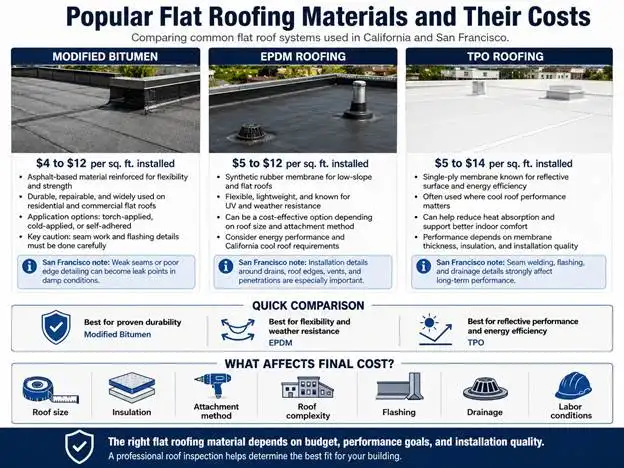
Choosing the right flat roofing material is one of the most important decisions in the replacement process. Each system has its own cost range, performance strengths, and maintenance considerations.
Modified Bitumen
Modified bitumen is an asphalt-based flat roofing material reinforced for added flexibility and strength. It is often used on residential and commercial flat roofs because it is durable, repairable, and familiar to many roofing contractors.
Modified bitumen may cost around $4 to $12 per square foot installed, depending on the specific product, installation method, and project requirements. It can be torch-applied, cold-applied, or self-adhered, and each method has different safety and performance considerations.
This system can be a practical option for property owners who want a proven flat roof material, but proper seam work and flashing details are essential. In a moisture-heavy environment like San Francisco, weak seams or poor edge detailing can become future leak points.
EPDM Roofing
EPDM is a synthetic rubber membrane used on low-slope and flat roofs. It is flexible, lightweight, and known for its resistance to UV exposure and weathering. EPDM has been used for many years and can be a cost-effective option in the right setting.
EPDM often falls around $5 to $12 per square foot installed, though pricing depends on membrane thickness, roof size, attachment method, and project complexity. While EPDM can perform well, property owners should consider whether a black membrane is the best choice for energy performance and cool roof compliance. White or coated options may be available, but the system should be reviewed against California requirements.
For San Francisco properties, EPDM may be appropriate in some cases, but the installation must be detailed carefully around roof edges, drains, vents, and penetrations.
TPO Roofing
TPO, or thermoplastic polyolefin, is one of the most popular modern flat roofing materials. It is a single-ply membrane known for its reflective surface, energy efficiency, and heat-welded seams. Because TPO is often white or light-colored, it is commonly considered for projects where cool roof performance matters.
TPO may cost around $5 to $14 per square foot installed in California, depending on membrane thickness, insulation, attachment method, roof complexity, and local labor conditions. Its reflective surface can help reduce heat absorption, which may support better indoor comfort and energy performance.
For San Francisco flat roofs, TPO can be a strong option when installed by experienced professionals. The quality of the seam welding, flashing, and drainage details will have a major impact on long-term performance.
Additional Costs to Consider
The roofing membrane itself is only one part of the total cost. Several additional expenses may affect the final estimate.
Old roof removal is one of the most common added costs. Tear-off may cost around $1.50 to $4 per square foot, depending on the number of existing layers, disposal needs, and roof access. While some projects may qualify for a roof recovery, removing the old roof often gives the contractor a better view of the underlying structure and helps identify hidden damage.
Deck repairs can also increase the final price. If moisture has damaged the plywood, framing, or roof substrate, those areas should be repaired before the new system is installed. Otherwise, the new roof may be placed over a weak foundation.
Insulation upgrades may also be required or recommended. Better insulation can improve energy performance, help meet code requirements, and support the overall roof assembly. This is especially important when replacing older flat roofs that may not meet current efficiency standards.
Drainage improvements are another key cost factor. Flat roofs should never be completely flat. They need proper slope and drainage paths to move water off the roof. If water sits for long periods after rain, the roof may need improved drains, scuppers, gutters, tapered insulation, or slope corrections. In San Francisco’s foggy and damp climate, drainage issues can shorten roof life and increase the risk of leaks.
Flashing work can also affect the estimate. Parapet walls, skylights, vents, HVAC curbs, chimneys, roof edges, and pipe penetrations all need careful waterproofing. These details are often where leaks begin, so they should not be rushed or overlooked.
Why Professional Installation Matters
Flat roof replacement requires skill, planning, and attention to detail. Unlike some steep-slope roofing systems, flat roofs rely heavily on membrane integrity, seam strength, proper slope, and precise flashing. A small installation mistake can lead to water intrusion, especially during heavy rain or prolonged moisture exposure.
A professional roofing contractor will evaluate the roof as a complete system. That includes the membrane, insulation, decking, flashing, drainage, vents, penetrations, and roof edges. Each part needs to work together to protect the building.
Working with a qualified flat roof repair company in San Francisco also helps ensure the project is aligned with local permitting requirements and applicable California energy standards. This can be especially important when warranty coverage depends on correct installation and approved materials.
Professional installation can also protect your long-term investment. A lower-cost contractor may seem appealing upfront, but poor workmanship can lead to leaks, repeated repairs, voided warranties, and premature replacement. In the long run, quality installation often costs less than fixing preventable problems later.
Repair or Replace: How to Know Which Option Makes Sense
Not every flat roof problem requires a full replacement. In some cases, targeted repairs may be enough to extend the life of the roof. Minor punctures, isolated seam issues, limited flashing problems, or small leak areas may be repairable if the rest of the roof is still in good condition.
Replacement may be the better option when the roof has widespread membrane deterioration, repeated leaks, trapped moisture, damaged insulation, poor drainage, or multiple aging roof layers. If repairs are becoming frequent, replacement may provide better long-term value than continuing to patch an old system.
Age also matters. If the flat roof is near the end of its expected lifespan, investing in repeated repairs may not be the most practical choice. A professional inspection can help determine whether repair or replacement is the better financial decision.
Reliable flat roof repair companies in San Francisco should explain the condition of the roof clearly and recommend the option that makes sense for the property, not simply push the most expensive solution.
Long-Term Value of a Quality Flat Roof
When comparing flat roof replacement costs, it is important to look beyond the initial price. A cheaper system may save money upfront, but if it fails early, leaks often, or requires constant maintenance, it may cost more over time.
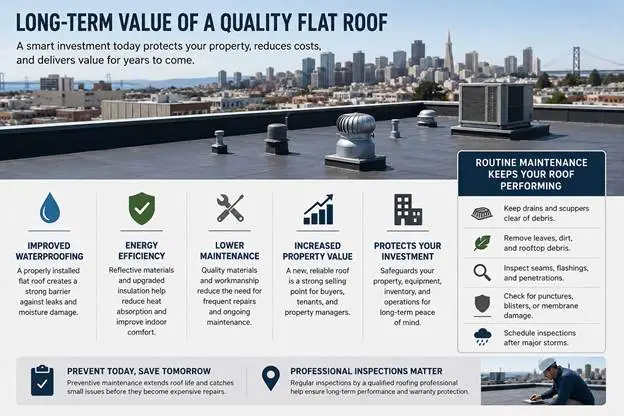
A high-quality flat roof can improve waterproofing, support energy efficiency, reduce maintenance needs, and protect the value of the property. Reflective materials may help lower heat absorption, while upgraded insulation can improve indoor comfort and reduce energy waste.
A new roof can also be a selling point. Buyers, tenants, and property managers often view a recently replaced roof as a major advantage because it reduces the likelihood of near-term repairs. For commercial properties, a dependable flat roof can also protect equipment, inventory, tenants, and business operations.
Routine maintenance is still important after replacement. Property owners should keep drains clear, remove debris, check for punctures, monitor seams, and schedule inspections after major storms or visible roof damage. Preventive maintenance helps extend roof life and catch small issues before they become expensive repairs.
Financing a Flat Roof Replacement
Flat roof replacement can be a significant investment, so many property owners explore financing options. Depending on the situation, these may include home equity loans, home equity lines of credit, personal loans, credit cards with promotional financing, or financing plans offered through roofing companies.
Before choosing a financing option, compare interest rates, repayment terms, fees, and monthly payment requirements. The goal is to make the project manageable without creating unnecessary financial strain.
Financing may be especially helpful when delaying replacement would lead to greater damage. For example, a leaking flat roof can quickly cause interior staining, mold concerns, damaged insulation, electrical risks, and structural problems. Addressing the roof sooner can help prevent more expensive repairs later.
Choosing the Right Flat Roof Contractor in San Francisco
The contractor you choose can have just as much impact on the final result as the roofing material itself. When comparing companies, look for licensing, insurance, local experience, flat roof expertise, warranty options, and clear communication.
A trustworthy contractor should inspect the roof carefully, explain the findings, review material options, discuss code and permit requirements, and provide a detailed estimate. They should also explain how they plan to address drainage, flashing, insulation, ventilation, and roof access.
For San Francisco property owners, local experience is especially valuable. The city’s dense neighborhoods, coastal weather, fog, wind exposure, and permitting requirements can create challenges that require practical knowledge. A contractor familiar with San Francisco flat roofs can provide recommendations based on real local conditions rather than generic roofing advice.
Invest in a Flat Roof Built for San Francisco Conditions
Replacing a flat roof in San Francisco is a meaningful investment, but it is also an opportunity to improve your property’s protection, energy performance, and long-term value. With 2026 costs influenced by materials, labor, access, permits, insulation, drainage, and code requirements, property owners should take time to understand what goes into a professional roofing estimate.
The right flat roof system should do more than cover the building. It should manage water properly, resist moisture exposure, meet applicable energy requirements, and hold up to the Bay Area’s unique climate.
If your roof is aging, leaking, or showing signs of wear, Apollo Roofing Company can help. As a trusted flat roof repair company in San Francisco, our team provides professional inspections, honest recommendations, and quality roofing solutions designed for local homes and commercial properties.
Need Flat Roof Help in San Francisco?
Do not wait for a small roofing issue to become a major repair. Whether you need a full replacement, leak repair, inspection, or professional guidance, Apollo Roofing Company is ready to help.
As one of the trusted flat roof repair companies in San Francisco, we provide dependable service, clear communication, and roofing solutions built around your property’s needs. Contact Apollo Roofing Company today to schedule a consultation and take the next step toward a safer, stronger, and more reliable flat roof.
