

San Francisco’s coastal setting is one of the qualities that makes the city so distinctive. Ocean air, cool fog, changing winds, and mild temperatures shape daily life throughout the Bay Area. Those same conditions, however, create a demanding environment for residential roofing systems.
A roof near the coast does not weather in exactly the same way as a roof farther inland. Salt carried through the air can settle on exposed metal components. Fog and humidity can keep roofing surfaces damp for extended periods. Wind can place additional pressure on shingles, flashing, edges, and other vulnerable areas. Over many years, these conditions can contribute to corrosion, biological growth, material deterioration, and recurring moisture problems.
For homeowners considering a residential roof replacement in San Francisco, understanding these coastal influences is valuable. Roof lifespan is not determined by material alone. Location, installation quality, ventilation, drainage, maintenance, and exposure all contribute to how successfully a roof protects the home.

Why San Francisco’s Coastal Climate Is Different
San Francisco has numerous microclimates, so roofing conditions can vary considerably from one neighborhood to another. A home regularly exposed to Pacific fog and wind may experience different wear than a more sheltered property farther inland.
The important point is that roofs in the city often deal with moisture and airborne salt repeatedly rather than occasionally. That ongoing exposure can gradually affect roof components even when there has been no dramatic storm or obvious roofing failure.
The Role of Salt Air in Roof Deterioration
Sea spray does not need to visibly coat a roof for salt exposure to matter. Fine salt particles can travel through coastal air and settle on roofing materials, fasteners, flashing, gutters, vents, and other exposed components.
Metal is particularly important to monitor because salt can accelerate corrosion when protective finishes become scratched, damaged, or worn. Flashing around chimneys, walls, skylights, and roof penetrations performs an essential waterproofing function, so deterioration in these areas can eventually contribute to leaks.
Salt exposure is usually a gradual process. A homeowner may not notice anything unusual from the ground while small areas of corrosion continue developing. This is one reason roof inspections are useful in coastal environments.
Constant Fog, Moisture, and Humidity
San Francisco fog does more than reduce visibility. It can also leave roof surfaces damp for long stretches, particularly on roofs receiving limited direct sunlight.
Persistent moisture creates conditions where moss, algae, mildew, and organic debris can remain wet longer. It may also make existing weaknesses more consequential. A small flashing defect or damaged roof surface can become more problematic when moisture repeatedly reaches the same location.
Drainage becomes especially important under these conditions. Valleys, gutters, scuppers, drains, and other pathways need to move water efficiently so moisture does not linger unnecessarily.
Wind and Storm Exposure Near the Bay and Pacific
Wind can affect roofing systems in several ways. Strong gusts may loosen aging shingles, stress roof edges, move debris across surfaces, and drive rain toward areas that normally receive less direct exposure.
Wind can also expose installation weaknesses. Fasteners, flashing edges, sealants, and transitions need to work as a system. When one component begins failing, repeated wind and moisture can accelerate the problem.
Homes in particularly exposed locations may therefore benefit from closer attention to perimeter details and roof penetrations during inspections.
How Salt Air Affects Different Roofing Materials
No roofing material is completely unaffected by its environment. Each type responds differently to moisture, salt, wind, sunlight, and temperature.
Understanding those differences helps homeowners make more informed decisions when repairing or replacing a roof.
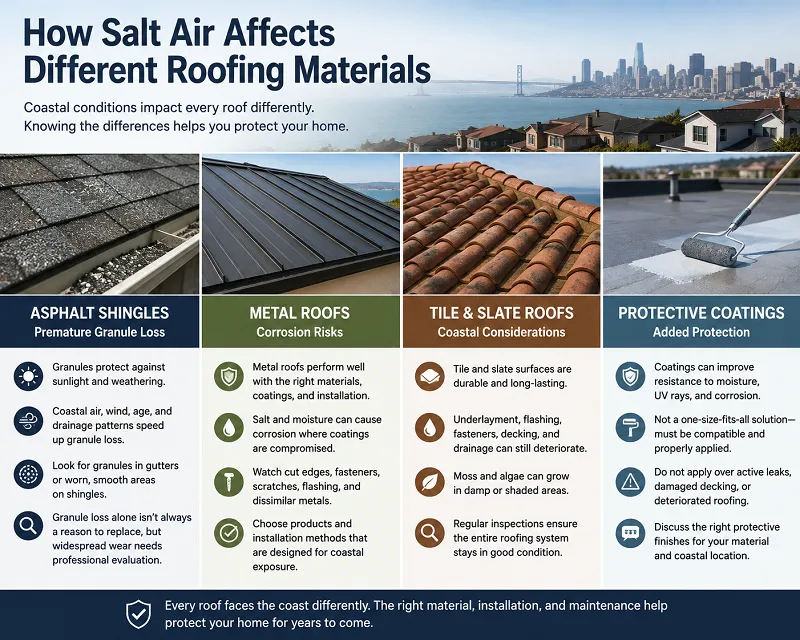
Asphalt Shingles and Premature Granule Loss
Asphalt shingles are widely used because they offer a practical balance of performance, appearance, and cost. Their surface granules help protect the underlying asphalt from sunlight and weathering.
Over time, granules naturally loosen. Coastal exposure, wind, foot traffic, age, and drainage patterns can contribute to wear. When significant granule loss occurs, the underlying shingle becomes more exposed to environmental stress.
Homeowners may notice granules collecting in gutters or areas where shingles appear smoother or more weathered than surrounding sections. Granule loss alone does not automatically mean replacement is required, but widespread deterioration deserves professional evaluation.
Metal Roofs and Corrosion Risks
Metal roofing can provide excellent performance when the appropriate materials, coatings, and installation methods are used. In coastal areas, however, corrosion resistance becomes especially important.
Salt deposits and moisture can accelerate deterioration where protective coatings are compromised. Cut edges, fasteners, scratches, flashing connections, and dissimilar metals deserve particular attention.
This does not mean metal roofing is unsuitable for San Francisco. It means product selection and installation details matter. A roofing system designed with the property’s exposure in mind is far more valuable than choosing metal based on material reputation alone.
Tile and Slate Roofs in Coastal Environments
Tile and slate are often associated with durability, and the primary roofing pieces themselves can perform for many years. However, homeowners should not assume that the visible tile or slate tells the whole story.
Underlayment, flashing, fasteners, battens, roof decking, and drainage components can deteriorate independently of the surface material. A roof may still look attractive from the street while hidden waterproofing materials underneath are aging.
Moss and algae can also appear in damp or shaded areas. Periodic inspections help determine whether the roof remains sound as a complete system.
Protective Coatings and Treatments That Help
Certain roofing systems can benefit from protective coatings or treatments intended to improve resistance to moisture, ultraviolet exposure, or corrosion.
These products are not universal solutions. A coating must be compatible with the existing roofing material and applied to a properly prepared surface. Applying a product over active leaks, damaged decking, or deteriorated roofing will not correct the underlying problem.
When planning a residential roof replacement in San Francisco, homeowners should discuss whether protective finishes are appropriate for the chosen material and location.
Signs Your Roof Is Being Damaged by Coastal Conditions
Coastal roof deterioration often develops gradually. Recognizing early warning signs can help homeowners address smaller concerns before moisture reaches the interior of the house.
Rust, Stains, or Corrosion on Roof Surfaces
Rust around flashing, gutters, vents, fasteners, or other metal components deserves attention. Discoloration can indicate that protective finishes are deteriorating or moisture is remaining in the area.
Small corrosion spots may sometimes be addressed before they spread. More advanced deterioration may require replacement of the affected component.
The important point is not to treat rust as purely cosmetic. Metal roof components frequently serve an important waterproofing purpose.
Moss, Algae, and Mold Growth from Persistent Fog
Green patches, dark streaks, or organic growth commonly appear where moisture lingers.
Growth itself can signal that an area is staying damp longer than surrounding roof surfaces. Heavy moss may also hold moisture against roofing materials and interfere with drainage.
Aggressive cleaning is not always the answer. Pressure washing or improper chemical treatment can damage some roofing products. The roof material and its condition should determine the safest maintenance approach.
Shortened Lifespan Compared to Inland Roofs
It is tempting to estimate replacement timing from the manufacturer’s expected lifespan alone, but real roofs rarely age according to a calendar.
A roof exposed to persistent moisture, salt, shade, wind, poor drainage, or inadequate ventilation may deteriorate differently from the same roofing product installed in a drier inland environment.
Installation quality is equally important. A well-installed roof that receives regular maintenance may perform considerably better than a poorly installed roof made from a theoretically longer-lasting material.
Homeowners should therefore judge roof condition through inspections and performance rather than age alone.
How to Protect Your Roof from Salt Air and Moisture
San Francisco homeowners cannot eliminate the coastal climate, but they can reduce avoidable roof deterioration through thoughtful material choices, maintenance, and early intervention.
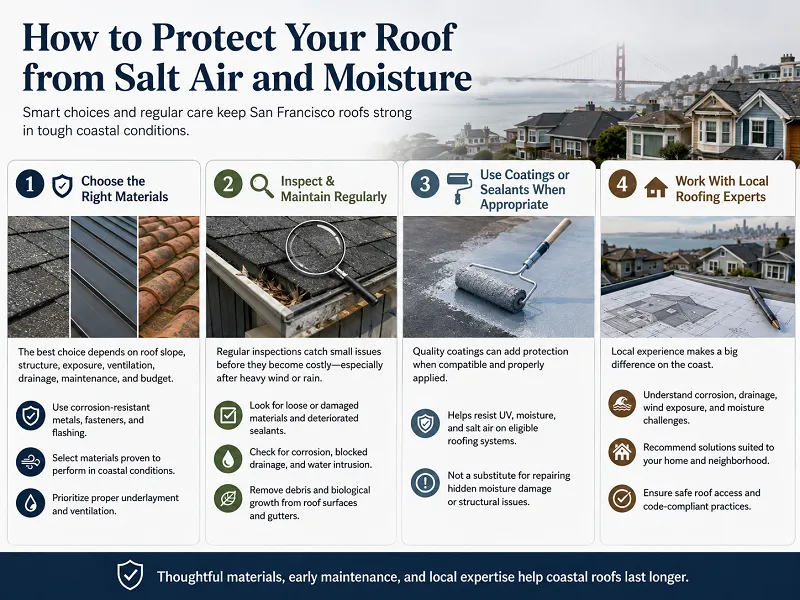
Choosing the Right Materials for Coastal Homes
The best roofing material is not simply the one advertised with the longest lifespan.
The right choice should account for the roof’s slope, structural capacity, exposure, architecture, ventilation, drainage, maintenance requirements, and budget. Corrosion-resistant components are particularly valuable where salt exposure is significant.
A roof should be designed as a complete system. Membrane or shingle selection matters, but so do flashing, fasteners, underlayment, ventilation, and edge details.
Regular Roof Inspections and Maintenance
Routine inspection is one of the simplest ways to protect a coastal roof.
A roofing professional can look for loose materials, deteriorated sealants, corrosion, flashing problems, blocked drainage, biological growth, and other signs that may be difficult to see from the ground.
Inspections are especially useful after periods of strong wind or heavy rain. Catching a displaced component before the next storm can prevent a relatively manageable repair from turning into interior water damage.
Applying Protective Coatings or Sealants
Coatings and sealants can be useful when they are appropriate for the roofing system and applied correctly.
They should not be viewed as substitutes for proper repair. If moisture is already trapped beneath the roofing or structural materials have deteriorated, covering the surface may hide rather than solve the problem.
A professional assessment can determine whether a coating is worthwhile or whether another repair approach is more appropriate.
Working With Local Residential Roofing Experts in San Francisco
Local roofing knowledge is particularly valuable in a city with varied architecture and neighborhood-specific exposure.
An experienced San Francisco roofer understands that a coastal home may require closer attention to corrosion, drainage, wind exposure, roof access, and moisture management. They can also evaluate how those conditions interact with the existing roofing material.
For homeowners considering residential roofing services in San Francisco, that local understanding can help create a solution based on the actual property rather than a generic roofing recommendation.
Why Professional Guidance Matters
Roof problems are not always easy to diagnose from the visible symptom.
A ceiling stain might originate from flashing several feet away. A cracked tile may be obvious while deteriorated underlayment beneath intact tiles remains hidden. Rust on one piece of metal may indicate a localized issue or broader corrosion developing elsewhere.
Professional roofers look at how these components interact. That system-level evaluation helps determine whether maintenance, targeted repair, or replacement makes the most sense.
It also helps homeowners avoid replacing an entire roof unnecessarily when a smaller repair would be appropriate, or repeatedly repairing surface symptoms when the roofing system has reached a point where replacement is more practical.
FAQs About Residential Roof Replacement in San Francisco
What roofing materials last longest in coastal San Francisco?
There is no single material that performs best on every San Francisco property. Tile, slate, properly protected metal systems, and quality asphalt products can all perform well when matched to the building and installed correctly. Roof design, drainage, exposure, underlayment, flashing, ventilation, and maintenance can have as much influence on longevity as the visible roofing material.
Does salt air really shorten a roof’s lifespan?
Salt air can contribute to faster deterioration, particularly on exposed metal components and areas where moisture remains present. The degree of impact depends on the property’s proximity to coastal exposure, roof material, protective coatings, maintenance, and installation quality. Salt is one factor among several that determine actual roof lifespan.
How often should coastal roofs be inspected in San Francisco?
An annual professional inspection provides a useful baseline for many homes, while additional checks can be worthwhile after significant storms, strong wind events, or visible changes to the roof. Older roofs or properties with a history of drainage and moisture problems may benefit from closer monitoring based on their individual condition.
Why Choose Apollo Roofing Company for Your San Francisco Home
San Francisco roofing requires more than knowing how to install shingles, tile, or membrane systems. The roof has to work with the building, surrounding environment, drainage, and local exposure.
Apollo Roofing Company helps homeowners evaluate roofing systems with those conditions in mind. Our team examines the visible roofing materials as well as important supporting components such as flashing, drainage areas, penetrations, and underlying conditions that may influence performance.
Rather than making decisions based solely on roof age, we help homeowners understand what is happening, why it matters, and which next step makes sense for the property.
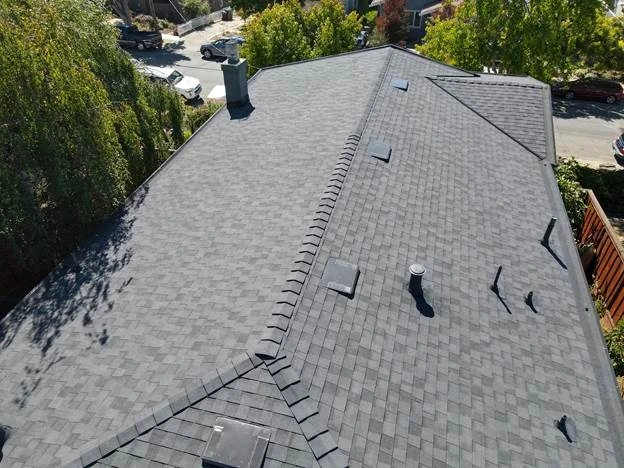
Call Apollo Roofing Company Today for Trusted Residential Roof Replacement in San Francisco
Coastal weather does not damage every San Francisco roof at the same pace, but salt, fog, moisture, and wind can expose weaknesses that become more expensive when ignored.
If you are noticing corrosion, recurring leaks, damaged roofing materials, persistent moss growth, or other signs of deterioration, a professional evaluation can give you a clearer understanding of your roof’s condition.
Contact Apollo Roofing Company today to schedule a roof evaluation and discuss your options. Whether your home needs maintenance, targeted repairs, or residential roof replacement in San Francisco, our team can help you make an informed decision built around the long-term protection of your property.
