

A commercial roofing estimate should tell you much more than how much a project might cost. For a building owner or property manager, a good estimate should help clarify what is wrong with the roof, what work is recommended, which materials will be used, and what could cause the final scope to change.
That information matters because commercial roofs are rarely simple. Rooftop HVAC equipment, drainage systems, penetrations, flashing, previous repairs, membrane condition, access limitations, and moisture below the surface can all influence the work required. Two contractors can inspect the same building and submit very different prices because they are not necessarily proposing the same solution.
Before choosing a contractor, take time to understand both the condition of your roof and what each proposal actually includes. A little preparation can make commercial roofing estimates easier to compare and help you make a more informed investment in your San Rafael property.
Know the Details of the Damage
Start with the reason you requested an estimate.
Did water appear after a heavy rain? Is there visible membrane damage? Has the maintenance team noticed recurring ponding, damaged flashing, loose materials, or leaks around rooftop equipment? Or is an aging roof simply requiring more frequent repairs?
Document what you know before the inspection. Note when leaks occur, where interior water appears, and whether the problem changes with wind or rainfall. Photographs, maintenance records, previous repair invoices, and information about earlier roof work can give the contractor useful context.
Keep in mind that the interior location of a leak does not always identify its rooftop source. Water can travel through insulation, decking, structural components, or other parts of an assembly before becoming visible indoors. A professional roof assessment is therefore more useful than assuming the wet ceiling tile directly identifies the failed roofing component.
Understanding the likely cause also becomes important if insurance may be involved.
Talk to the Insurance Company
If roof damage may have resulted from a covered event, review your commercial property insurance policy and contact your insurer or insurance professional before making assumptions about coverage.
Policies differ considerably. Coverage may depend on the cause of loss, policy language, deductibles, exclusions, roof condition, and other factors. Damage related to a specific covered event may be treated differently from deterioration caused by age, deferred maintenance, or long-term exposure.
Building owners should also avoid assuming that filing or avoiding a claim is automatically the better financial decision. The appropriate choice depends on the policy, extent of damage, deductible, and circumstances surrounding the loss.
Keep inspection reports, photographs, invoices, correspondence, and other relevant records organized. If a claim is filed, good documentation can make it easier to establish what happened and what roofing work has been recommended.
Consider the Age and Condition of the Roof
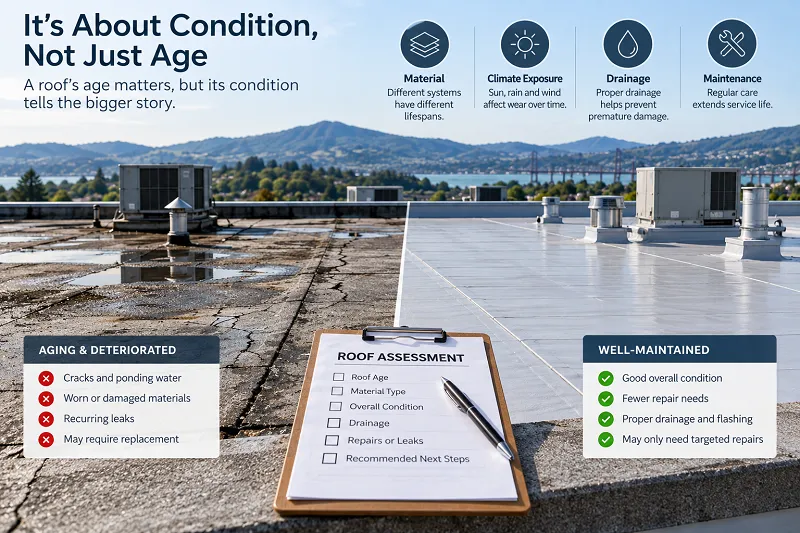
Roof age is useful information, but it should not be treated as a countdown clock.
Commercial roofing systems can have very different service lives depending on material, installation quality, climate exposure, drainage, maintenance, foot traffic, repairs, and rooftop equipment. Even two roofs using similar materials can age differently.
Condition is therefore just as important as installation date.
A roof with isolated, repairable problems may not require complete replacement simply because it is older. On the other hand, widespread deterioration, recurring leaks, saturated materials, extensive seam or flashing problems, or repeated repair expenses may make continued patching less practical.
When requesting an estimate, ask the contractor to explain why repair, restoration, or replacement is being recommended. The answer should connect the proposed work to observable roof conditions rather than relying only on age.
Know the Options in Commercial Roofing Materials
Understanding the basic roofing system proposed for your building makes estimates easier to evaluate.
Commercial properties may use single-ply membranes, modified bitumen, built-up roofing, metal systems, coatings, or other assemblies depending on roof design and existing conditions. Each option has its own installation requirements, compatibility considerations, maintenance needs, and cost factors.
Material price alone should not determine the decision.
For example, the least expensive product may not be the most practical choice if significant preparation is needed to make it compatible with the existing assembly. Likewise, a more expensive system does not automatically make sense for every building.
Ask why a particular system is being recommended for your property. A contractor should be able to discuss factors such as drainage, roof slope, penetrations, existing materials, building use, installation requirements, and long-term maintenance.
Look Beyond the Visible Roofing Surface
One of the biggest challenges with commercial roofing estimates is that not every condition is visible during an initial inspection.
The exposed membrane or roof covering may be only one layer of a larger assembly. Depending on the system, insulation, cover boards, decking, fasteners, vapor-control components, and other materials may sit below the surface.
Moisture trapped within the assembly can significantly affect project scope. So can deteriorated decking or insulation that is discovered after removal begins.
Ask contractors how they evaluate concealed conditions and how unforeseen work will be handled if deterioration is found. A proposal that clearly explains allowances, unit pricing, or authorization procedures can be more useful than one that simply presents a low initial total without addressing uncertainty.
Ask Other Building Owners for References
References remain valuable, particularly when they come from owners or managers responsible for buildings similar to yours.
Instead of asking only whether they liked the contractor, ask more specific questions. Did the project stay reasonably aligned with the agreed scope? Were changes explained before additional work proceeded? Did the contractor communicate effectively with tenants or property management? Was the site kept organized? How did the roof perform after completion?
You can also ask prospective contractors for examples of comparable commercial work.
Licensing and insurance should be verified as part of the vetting process. Building owners should also understand any project-specific bonding or documentation requirements rather than assuming every commercial project has identical requirements.
Price matters, but so does the contractor’s ability to complete the proposed scope correctly and communicate when conditions change.
Have Each Contractor Break Down Costs and Scope
A commercial roofing estimate becomes far more useful when you can see what the contractor is actually proposing.
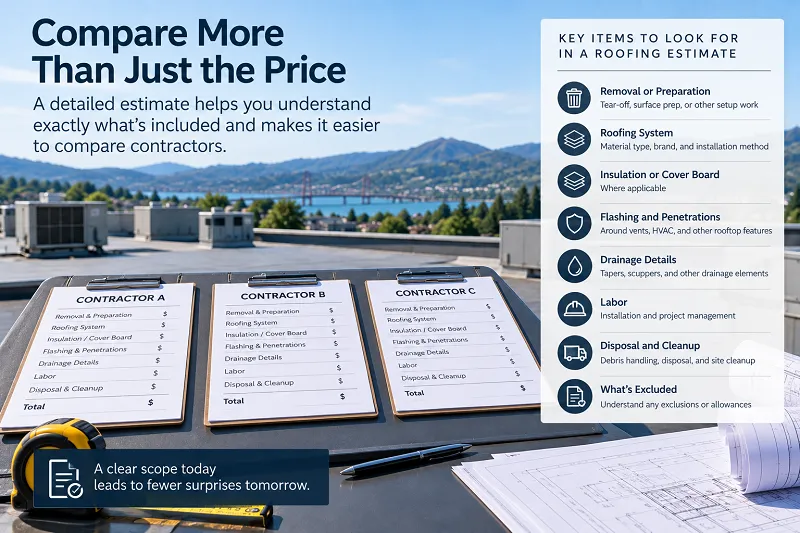
Look for information about removal or preparation, the roofing system, insulation or cover board where applicable, flashing, penetrations, drainage details, labor, disposal, cleanup, and other significant components of the project.
You should also understand what is excluded.
Suppose one contractor’s price is noticeably lower. That does not necessarily mean the contractor offers a better value. The estimate might exclude work included elsewhere, specify a different material, assume less extensive preparation, or address rooftop details differently.
Rather than comparing totals first, compare scopes first.
Ask each contractor to clarify unclear language and explain how additional work would be priced if concealed deterioration is discovered. The goal is not necessarily to force every proposal into the same format. It is to understand whether you are actually comparing equivalent solutions.
Think About Building Operations During the Project
Commercial roofing work happens above an active property, and that can introduce considerations that are easy to overlook when focusing only on price.
Ask how crews will access the roof, where materials and equipment will be staged, and how debris will be managed. Buildings with tenants, customers, deliveries, sensitive equipment, or restricted access may require additional coordination.
Noise, odors, temporary closures, parking restrictions, and rooftop HVAC equipment can also affect project planning depending on the roofing system and work involved.
For property managers, this information can be just as important as the installation schedule. A well-planned roofing project should account for the building below the roof, not simply the roofing materials above it.
How Many Roofing Estimates Should You Get?
Getting multiple estimates can provide useful perspective, but the number of proposals matters less than their quality.
Two or three detailed proposals from qualified commercial contractors may reveal significant differences in recommended solutions, materials, exclusions, and project approach. If one estimate is dramatically higher or lower than the others, investigate why rather than automatically rejecting or accepting it.
Ask questions until you understand what each contractor saw and what each company intends to do.
If recommendations differ substantially, the explanation behind those recommendations becomes especially important. One contractor may be proposing targeted repairs while another recommends replacement. Understanding the roof conditions supporting each approach can help you evaluate the proposals more intelligently.
Frequently Asked Questions About Commercial Roofing Estimates
What should a commercial roofing estimate include?
A useful estimate should identify the proposed scope of work, roofing materials or system, significant preparation or removal requirements, flashing and penetration work, cleanup, and relevant warranty information. It should also explain major exclusions and how unforeseen conditions will be addressed if they are discovered during the project.
Why are commercial roofing estimates sometimes so different?
Differences can result from materials, labor assumptions, roof preparation, access, drainage work, flashing details, insulation, removal requirements, disposal, warranties, and how each contractor addresses existing conditions. Comparing only the final totals can hide these differences, so reviewing the complete scope is essential.
Can a commercial roof be repaired instead of replaced?
Sometimes. The answer depends on the type of roofing system, location and extent of deterioration, moisture conditions, previous repairs, and overall roof condition. A professional assessment can help determine whether a targeted repair remains practical or whether more extensive work should be considered.
Should I choose the lowest commercial roofing estimate?
Not automatically. A lower proposal may represent good value, but it could also include a different material or narrower scope. Compare materials, preparation, flashing, exclusions, warranties, contractor qualifications, and procedures for unexpected work before deciding which proposal best addresses the building’s needs.
How can I prepare for a commercial roof inspection?
Gather available information about the roof’s installation date, previous repairs, leak history, warranties, maintenance, and known problem areas. Providing photographs and records can help the contractor understand recurring issues. Make sure appropriate roof access is also available so the contractor can conduct a thorough evaluation.
Get a Commercial Roofing Estimate From Apollo Roofing Company
A commercial roof protects far more than the top of a building. When it fails, water intrusion can disrupt tenants, damage interiors and equipment, interfere with operations, and turn a manageable roofing problem into a much larger property issue.
That is why a commercial roofing estimate should provide clarity, not simply a price.
Apollo Roofing Company serves commercial property owners and managers in San Rafael and surrounding areas. Our team can assess existing roof conditions, discuss appropriate roofing options, and help you understand the scope behind the estimate.
If your commercial roof is leaking, showing signs of deterioration, or approaching the point where repeated repairs no longer make sense, contact Apollo Roofing Company to schedule an assessment. Get the information you need to plan the next step before a roofing problem starts making decisions for you.
